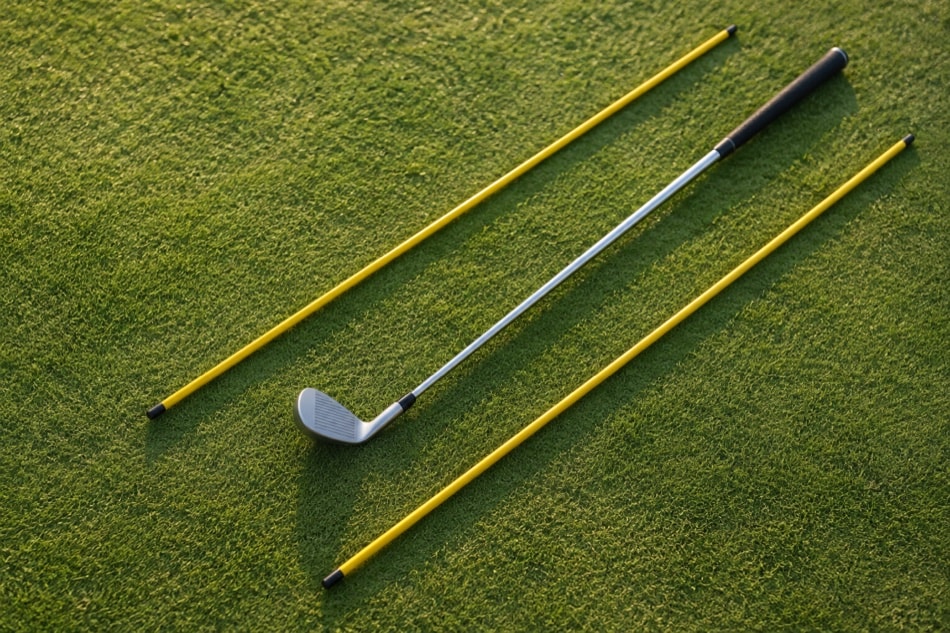
Alignment tools reveal setup
A plain rod on the ground can show target line, foot line or ball position during practice. Use it before the shot, then remove it when rules or safety require. Periodically practise without it so your eyes learn the picture.
Begin below full speed so balance and strike stay visible. Repeat only while attention is sharp, then change the target or lie to learn whether the motion can travel. Keep the adjustment that improves the pattern without adding strain. When the result changes, ask whether the motion changed too or whether ordinary variation is appearing. That question prevents a quick reaction to every ball.
Mirrors and video show relationships
A mirror can help with posture and slow rehearsal; video can show the motion from a stable angle. Both are most useful when you know what to look for. Checking every swing encourages posing and distracts from ball flight.
Use neutral feedback: where the ball began, how it curved, where the club met the ground and whether the finish was balanced. Those observations are more reliable than calling a swing good or bad because it felt familiar. A brief note after the session can preserve the pattern without turning practice into constant record keeping. Describe only what you could actually observe.
Weighted tools need a narrow purpose
A heavier practice club changes timing as well as effort. Use general speed or movement tools in a separate, controlled block and return to a normal club afterward. More strain is not evidence of better practice.
Rehearse the movement without a ball, then make a small shot and finally return to a normal swing. That progression gives the body time to organise the change while the real flight still has the final vote. If the full motion loses the idea, shorten it again instead of forcing a correction at speed. Gradual transfer is part of the work, not a retreat.
Launch data needs a question
A launch monitor can clarify strike, start direction, launch and spin when interpreted in context. Choose the measurement linked to your current task. Staring at every available value makes an ordinary shot look like a laboratory report.
Avoid adding a second correction when the first attempt looks untidy. Golf learning is noisy, and one ball cannot settle the question. Look for a repeatable trend across an attentive practice block. Keep the target large enough that you can notice motion and contact without reacting to a narrow outcome. Precision can increase after the pattern becomes more dependable.
Rangefinders provide information, not decisions
Distance information can support club choice, while the golfer still judges lie, wind, slope and risk. Under the Rules, a device may provide allowed distance or direction information, subject to any local restriction. It should shorten uncertainty, not slow the group.
Take the idea to the course as one short cue, not a technical speech. Choose the shot, make the rehearsal and commit. Save detailed diagnosis for a practice area where time and safety allow it. Between shots, let attention move to the walk, the surroundings and the next decision. Constant mechanical checking makes a round feel longer and rarely produces clearer information.
Rules and research in context
The R&A's Rule 4 requires conforming clubs and balls, limits a player to no more than 14 clubs and allows equipment to provide distance or direction information subject to the Rule and any local restriction.
Connect the work
Carry this idea into Club fitting and choosing a golf ball, A pre-swing checklist: setup, alignment and posture and Practice that transfers to the course: games, targets and variety. The links between technique, practice and decisions are where a range change becomes a usable golf skill.