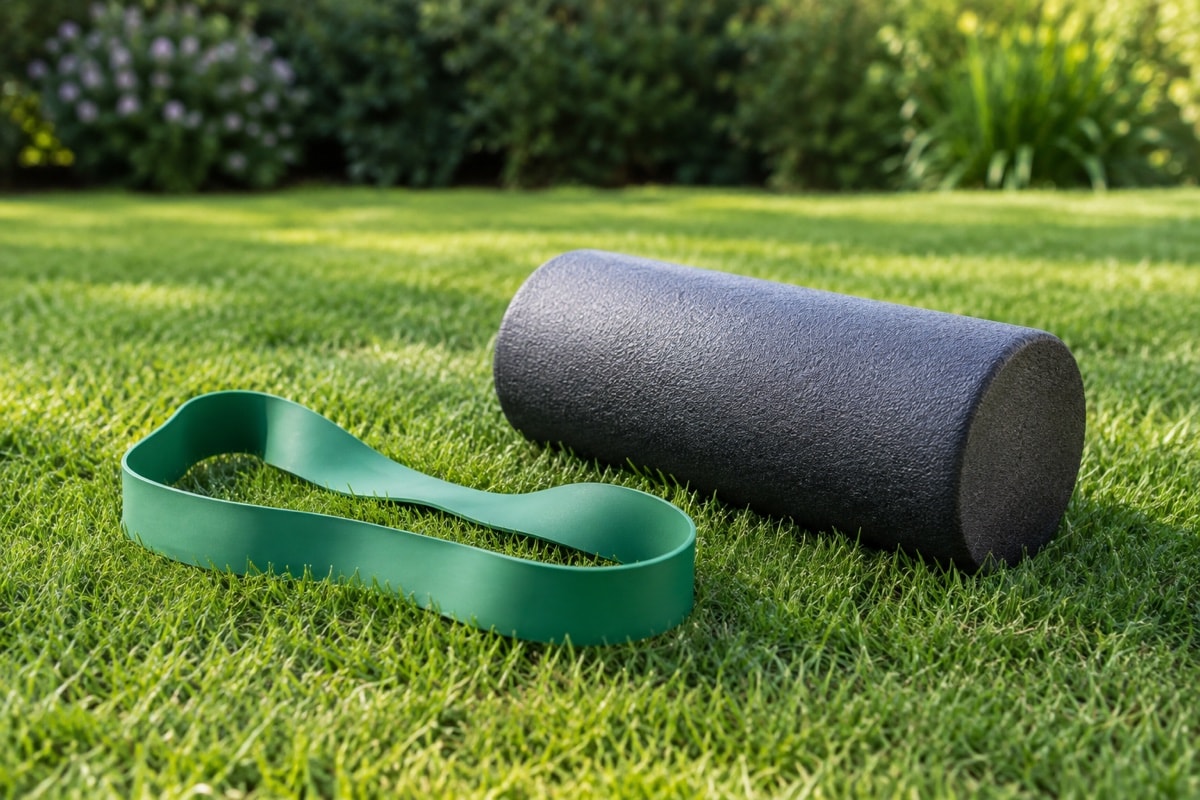
Use different kinds of activity
Aerobic work supports general capacity, muscle-strengthening work challenges force, and balance practice develops control. Variety matters because golf asks you to walk, stabilise and create speed rather than rely on one quality.
Give the idea a fair test with a familiar club and a comfortable target. Watch the ball's starting direction, curve and contact before changing anything else. A useful cue should make the pattern clearer, not make you chase a perfect position. Pause between attempts long enough to picture the next shot, and keep the setup consistent so the feedback has a stable reference.
Strengthen broad patterns
Squat, hinge, push, pull, carry and rotate in forms appropriate to your experience and space. Keep technique controlled and leave room to recover. The purpose is a durable base for movement, not a contest with a number.
Begin below full speed so balance and strike stay visible. Repeat only while attention is sharp, then change the target or lie to learn whether the motion can travel. Keep the adjustment that improves the pattern without adding strain. When the result changes, ask whether the motion changed too or whether ordinary variation is appearing. That question prevents a quick reaction to every ball.
Warm up dynamically
Begin with easy walking and joint movement, then turn through the shoulders, back and legs before making golf swings. Progress from small wedge motions toward longer clubs. A warm-up prepares you to play; it is not the time for a demanding workout.
Use neutral feedback: where the ball began, how it curved, where the club met the ground and whether the finish was balanced. Those observations are more reliable than calling a swing good or bad because it felt familiar. A brief note after the session can preserve the pattern without turning practice into constant record keeping. Describe only what you could actually observe.
Build mobility without forcing range
Explore comfortable movement through hips, upper back and shoulders while breathing normally. Yoga can be a general movement practice, but positions should be adapted to the individual and approached with appropriate safety.
Rehearse the movement without a ball, then make a small shot and finally return to a normal swing. That progression gives the body time to organise the change while the real flight still has the final vote. If the full motion loses the idea, shorten it again instead of forcing a correction at speed. Gradual transfer is part of the work, not a retreat.
Progress around your golf
Add volume or difficulty gradually and notice how the work affects practice and play. Hard sessions placed beside long rounds may reduce coordination. A plan should leave enough energy for the skill you are trying to express.
Avoid adding a second correction when the first attempt looks untidy. Golf learning is noisy, and one ball cannot settle the question. Look for a repeatable trend across an attentive practice block. Keep the target large enough that you can notice motion and contact without reacting to a narrow outcome. Precision can increase after the pattern becomes more dependable.
Rules and research in context
The National Institute on Aging explains aerobic, muscle-strengthening and balance activity as distinct types and notes the value of variety, a useful framework for general golf fitness.
AAOS OrthoInfo describes common trouble areas for golfers and advises warming up before a round by moving the shoulders, back and legs before progressing from shorter clubs toward the driver.
A study in the British Journal of Sports Medicine examined active dynamic warm-ups in elite male golfers; that narrow setting supports a progressive warm-up without promising the same outcome for everyone.
Know when to stop. Sharp, persistent or worsening pain, numbness, or a new or unexplained balance problem is a reason to stop and see a health care provider instead of playing through it.
This is general information, not medical advice.
Connect the work
Carry this idea into Balance in the golf swing, Where power comes from: rotation, sequence and clubhead speed and Aches, overuse and recovery: looking after your body as a golfer. The links between technique, practice and decisions are where a range change becomes a usable golf skill.